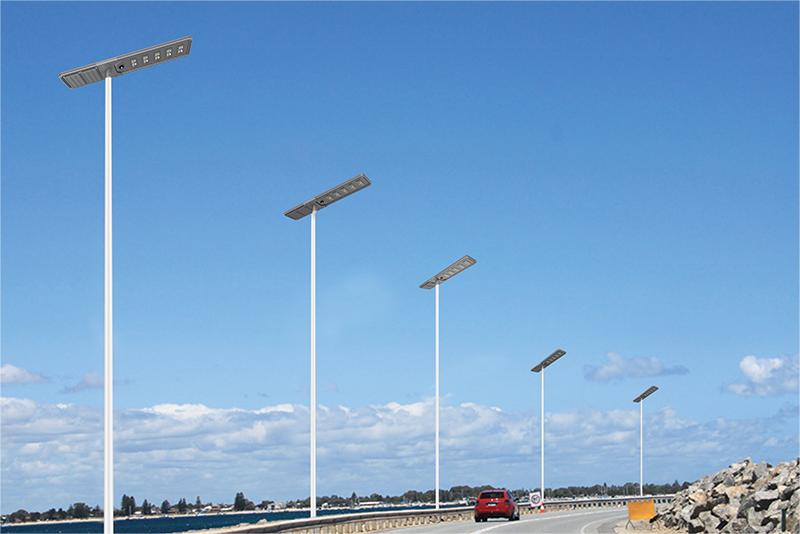
Solar streetlights can indeed function during overcast or rainy weather. The "Sowlay" solution employs a comprehensive safeguard system—integrating energy storage, power consumption management, and a backup power source—to ensure uninterrupted illumination by combining battery storage with grid power.
Solar Streetlights Can Remain Lit During Rainy Weather
Many assume that solar streetlights rely solely on stored battery power during overcast or rainy days; however, two key factors are often overlooked.
First, photovoltaic (PV) panels do not stop generating electricity entirely when it is cloudy or raining. They can still convert diffused light—filtered through cloud cover—into electrical energy, albeit at a much lower output than on a sunny day. This modest, ongoing charge helps slow the depletion of the battery, extending the system's operational duration.
Second, the actual runtime is determined by a combination of battery capacity and power consumption strategy. In the industry, a well-designed off-grid solar streetlight can typically handle 3 to 5 days of overcast or rainy weather, while higher-end configurations can manage 5 to 8 days. Many integrated solar lighting products are also designed to last for about 5 to 7 days under such conditions. Consequently, most high-quality products can reliably navigate typical periods of inclement weather.
The Unique Advantage of the "Sowlay" Solution: Eliminating "Runtime Anxiety" via Grid Integration
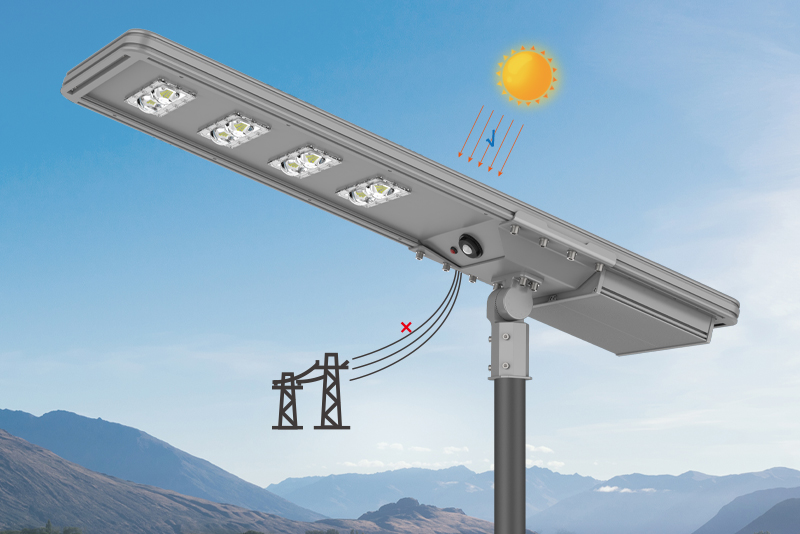
The "Sowlay" product you mentioned has a rated runtime of 2–3 days during overcast or rainy weather. While this figure may not be exceptionally high by industry standards, the system’s true strength lies in its design: it automatically switches to grid power when the battery level drops below 20%.
Essentially, this is a hybrid power system. While a solar streetlight is inherently an off-grid device, this configuration upgrades it into a "solar-first, grid-backed" system. If a prolonged period of rain or clouds exceeds the battery's capacity, the system seamlessly switches to the electrical grid, ensuring that lighting remains uninterrupted regardless of extreme weather. Advanced grid-integration controllers can execute this switch in under 10 milliseconds—a transition so fast that it has virtually no impact on the lighting experience.
In short, the "Sowlay" solution enables the use of solar streetlights even during rainy weather, ensuring reliable, year-round, all-weather performance. Look Beyond the Brand: 4 Key Metrics for Evaluating Solar Streetlights
When evaluating solar streetlights—specifically their reliability during overcast or rainy weather—focus on these four quantifiable criteria:
① Battery Capacity (Ah) and Type
Think of the battery as the "fuel tank" that determines runtime. Don’t just look at the wattage of the LED light source; check the battery’s capacity in ampere-hours (Ah). For instance, a 30W streetlight consuming approximately 282Wh per day would require a battery capacity of about 846Wh to sustain operation through three consecutive rainy or cloudy days—roughly 75Ah for a 12V system. Many low-cost products on the market come with only a 20Ah battery, which would struggle to last even half a day in poor weather. As for battery chemistry, Lithium Iron Phosphate (LiFePO4) is the preferred industry standard due to its long cycle life (over 2,000 cycles) and superior safety profile.
② Photovoltaic (PV) Panel Power (Wp)
The PV panel determines how quickly the system can "recharge" during sunny weather; if the battery is the fuel tank, the PV panel is the fuel nozzle. A useful rule of thumb is: Required PV Power ≈ Total Battery Storage Capacity ÷ Effective Daily Sunshine Hours ÷ System Efficiency. For the aforementioned system—which requires 900Wh of storage and operates in a location with 4 hours of effective daily sunlight—a PV panel with a capacity of approximately 320W is needed. If the PV panel is undersized, the battery will fail to recharge fully during sunny intervals, leading to a "power deficit cycle."
③ Controller Intelligence
A high-quality controller can significantly extend runtime during periods of poor weather through features like multi-level dimming and motion sensing (for pedestrians or vehicles). For example, the controller might automatically reduce power output to 50% during the latter half of the night, or drop it further to 20% (or a pulsed mode) when the battery level falls below 40%—while instantly returning to full brightness when motion is detected. Such strategies can extend the system's runtime during overcast or rainy weather by two to three times. Furthermore, controllers utilizing MPPT (Maximum Power Point Tracking) technology offer significantly higher charging efficiency compared to standard PWM (Pulse Width Modulation) controllers.
④ Capability for grid-supplemented or hybrid power supply
For locations such as major urban thoroughfares or transport hubs—where lighting interruptions are unacceptable—a grid-supplemented power configuration is essentially a mandatory requirement. This approach allows you to strike a balance between initial investment and long-term reliability, avoiding the need for an excessive, costly over-provisioning of batteries and solar panels to cope with extreme weather.
Summary
While solar streetlights can function during overcast or rainy weather, the questions of "how long they can last" and "how that duration is guaranteed" are distinct issues. Pure off-grid systems have a physical limit to their runtime; if the duration of poor weather exceeds the system's design specifications, lighting quality will degrade, or the lights may fail entirely. Solutions like those offered by Sowlay fundamentally address the challenge of maintaining reliable lighting during prolonged periods of extreme weather. When making a purchase, carefully evaluate battery capacity, solar panel power output, and controller management strategies—and determine whether a grid-backup connection is necessary—to ensure a choice you won’t regret.





 English




 Scan WhatsApp
 Scan Wechat
 Scan WhatsApp
 Scan Wechat
 Consult Now